flowchart TD
    B{"Make a Choice."}
    B --> C["You pick the car"]
    B --> D["You pick goat A"]
    B --> E["You pick goat B"]

    C --> F["Host must reveal a goat"]
    D --> G["Host must reveal the other goat"]
    E --> H["Host must reveal the other goat"]

    F --> I["Switch loses"]
    G --> J["Switch wins"]
    H --> K["Switch wins"]
15 Probability Intuition
15.1 Always Account for Variable Change.
You stand on a game-show stage in front of three closed doors. Behind one is a car. Behind the other two are goats. You pick a door, but nothing has been opened yet, so your first choice is exactly what it looks like: a blind guess.
Then the host steps in.
The host knows where the car is. The host opens one of the other doors and reveals a goat. Now only two closed doors remain: the contestant’s original door and one other. The host offers a switch.
That is the whole setup. No formulas are needed yet. Just notice what the scene feels like. Most people immediately reach for the same conclusion: two doors left, so now it must be 1:1—or fifty-fifty.
That feeling is the trap.
Famously, even mathematically trained readers and PhD’s wrote in very confidently insisting the answer had become fifty-fifty.
And they were all wrong.
Where the feeling goes wrong
The scene looks balanced only if you treat the host as neutral. But the host is not neutral. The host is part of the mechanism. Your first pick was random. The host’s reveal is not.
The host already knows where the car is and is not free to open just any remaining door. The host must reveal a goat. That means the reveal is carrying information, carrying a full change in the underlying structure at play.
At the start, there are three equally plausible worlds. In one of them, the original pick is the car. In the other two, the original pick is a goat. If the original pick is the car, switching loses. If the original pick is a goat, the host’s forced reveal leaves the car behind the only remaining unopened door. Two starting worlds favor switching. One does not.
So before the host opens anything, your original door is sitting on about a 33% chance of being right. The other two doors together hold about 67%. In odds language, that is already something like 2:1 against your first choice being correct. Then the host opens a goat door, and most people emotionally flatten the whole thing into “one versus one.” But the structure underneath never became even.
A good way to feel that more clearly is to stretch the scene. Imagine one hundred doors instead of three. One hides the car. You pick one. The host opens ninety-eight goat doors and leaves your original door plus one other still closed. The stage still ends with two unopened doors, but the feeling of “now it must be even” becomes much harder to hang onto. The host’s action is constrained, and that constraint changes what the remaining unopened door means.
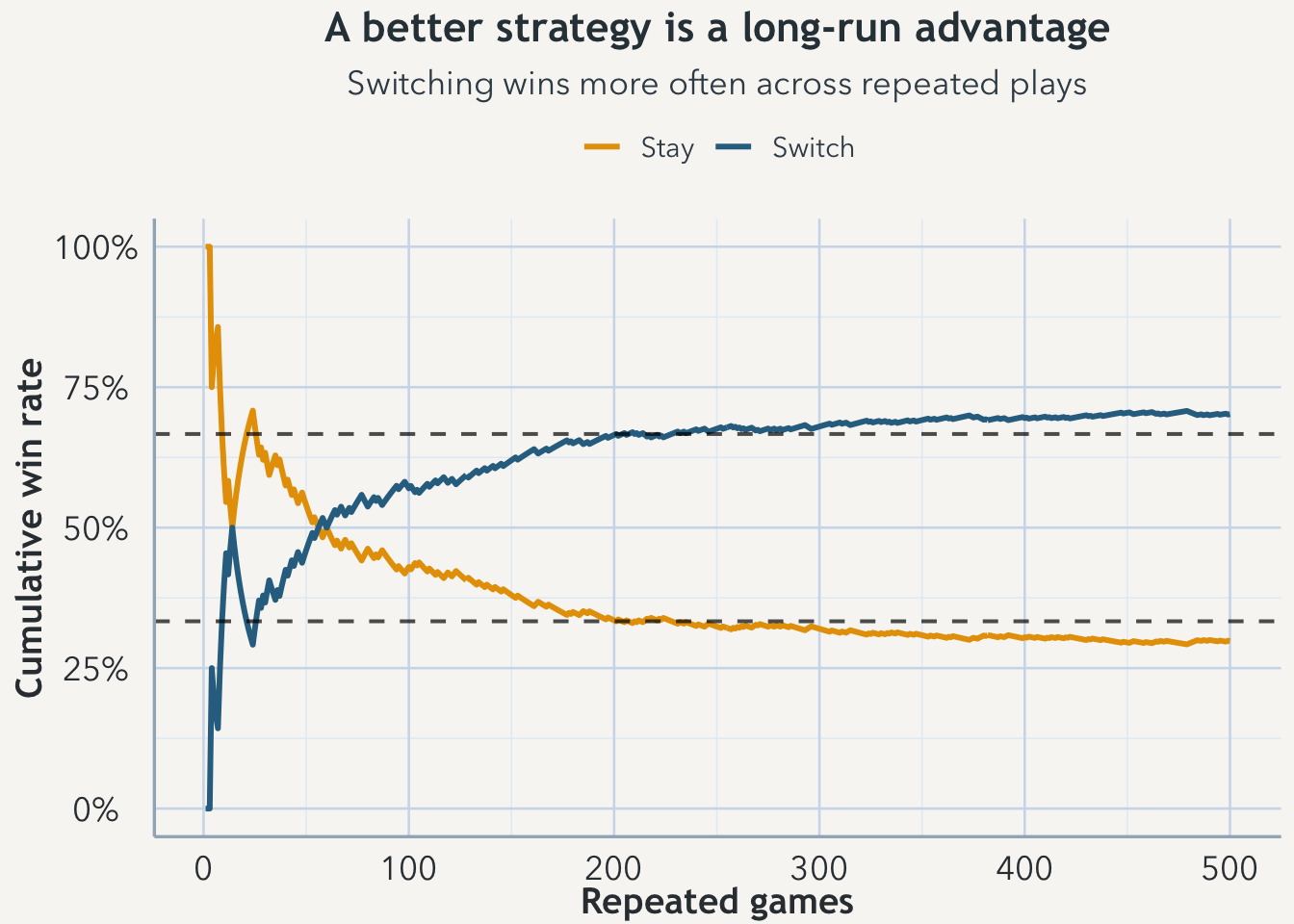
In the movie 21, that is exactly where Ben’s warning lands: always account for variable change. His point is that the host’s move changes the information in the scene. It collapses onto the one remaining unopened door. That is why Ben explains it as about 66%, or in rough odds language, about 2:1 in favor of switching. Nothing mystical happened to the second door. The structure did the work.
The important distinction is not between “switch” and “stay” as an individual choice. It is between seeing one choice and the underlying mechanism over many choices. A strategy advantage does not mean the next outcome owes you anything. It means that if you dropped yourself into this same structure again and again and again, one choice would beat the other more often in the long run.
That is the part people resist. They want probability to behave like a promise. It does not. It behaves more like a climate than a weather report. It tells you what kind of world you are in, what kinds of outcomes are common there, and what kinds are still possible even when they are less likely. The next play can still go against the better move. A long-run edge is not a promise about any one turn.
Why this chapter matters outside a game show
Monty Hall is useful because it catches a habit of mind that shows up everywhere else. People see the current arrangement and assume the current arrangement contains the whole story. They see two options and talk themselves into a balanced world. They see a short run in a dashboard, a dramatic week-to-week change, or a cluster of unusual outcomes and start speaking as if the process underneath must have changed.
Sometimes it has. Often it has not. What changed was the stretch of the pattern you happened to notice.
Probability is not there to tell you what the next case owes you. It is there to describe what kind of world you are in if the same mechanism keeps producing outcomes. A real edge can still lose today. A real pattern can still look messy up close. A surprising single result does not cancel the long-run structure that produced it.
That is also why odds do not rescue you from the basic intuition failure here. Odds and probability are two ways of describing the same repeated process. Probability asks how often the event happens out of all cases. Odds ask how often it happens relative to how often it does not. Those frames matter, but neither one changes the underlying world.
Gambling and Sports
Casinos live on this confusion. They do not need to win every hand, spin, or roll. They need a small edge that keeps paying over repetition. Players, on the other hand, often experience the game one result at a time. A lucky streak feels like proof. A bad beat feels like injustice. But the house is not thinking in moments. It is thinking in volume.
Sports make the same lesson feel stranger because the improbable happens in public, and everyone remembers it. Heavy favorites get upset, underdogs win. Miracles happen (A Minnesotan loves hockey). That does not mean probability failed. It means low-probability events still occur in a probabilistic world. “Unlikely” is not the same as “impossible.” In fact, one of the easiest mistakes in sports and betting is to treat any upset as evidence that the prior probabilities were meaningless. They were not meaningless. They just were never guarantees.
That is why both gambling and sports are useful intuition checks before statistics. They force you to hold two truths at once: the better side does not always win, and the better side can still be the better side. Just ask Nathan MacKinnon.
Takeaway
Monty Hall matters because it separates snapshot symmetry from process symmetry. The host’s reveal changes what the remaining doors mean. Probability is about what happens more often when the same rules keep running, not about what a single moment appears to promise.